Today, newspaper De Financiële Telegraaf published a piece called Weerstand tegen ‘woke’ personeelsbeleid groeit (EN: Growing resistance against ‘woke’ personnel policy), following a poll among HR-professionals by request of Visma YouServe. However, from the results of this poll one cannot conclude whether the resistance is increasing - the title is thus not correct. Though at first glance, the results are worrying: almost one in five participants supports statements as ‘diversity policy is nonsense’ or ‘it is woke and leads to unnecessary polarization’, this also means that over 80% of the participants disagrees with these statements. Even among the younger participants, whose judgements were on average more critical, over 70% disagreed. Important detail: no positive statements were included in the poll.
It doesn’t surprise me that organizations are struggling with support for diversity policy, and that HR-employees experience resistance. At the same time, it is important to also keep hearing positive sounds and to keep paying attention to the nuances.
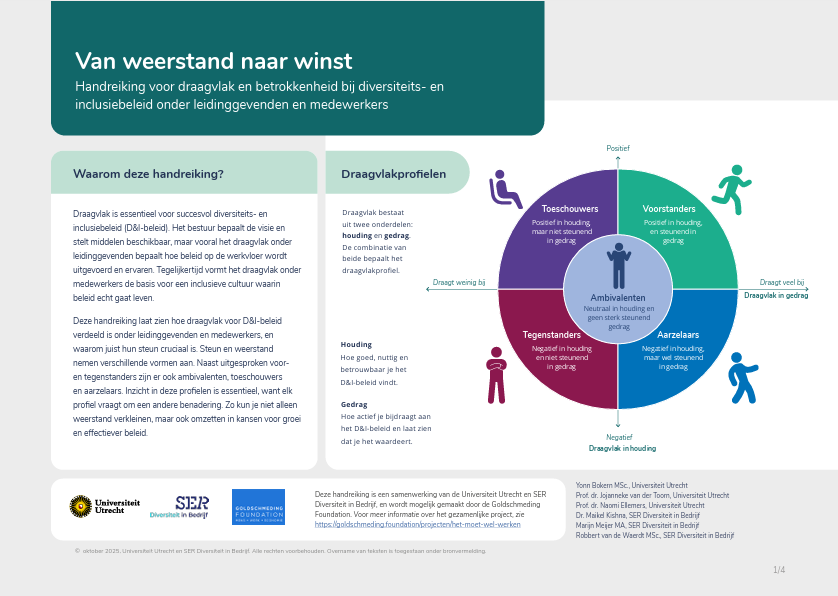
Our research with the Netherlands Inclusivity Monitor shows a more nuanced picture of support for D&I policy. There are not only distinct advocates and opponents, but also employees who support the policy and mainly question the execution. Precisely that group offers valuable information for HR-professionals.
Criticism may come faster and be louder today, and HR-professionals - often responsible for the policy - are directly involved. But how can one respond to this?
For that reason, we developed a new handout, which offers practical advice to better understand support, hesitation and resistance and how to effectively deal with it.
Download our handout Van Weerstand naar Winst (EN: From Resistance to Gain).
Most important findings from the handout:
1. Support is more than for or against. Not everyone is distinct champion or opponent. There are also ambivalent employees, reluctants and bystanders.
2. Resistance often is not refusal. The group which is truly against D&I policy, is smaller than expected. More often, it involves unfamiliarity, insecurity or critical questions.
3. Managers are crucial. They typically see themselves as champion or reluctant: convinced of the importance of D&I, but sometimes critical on the execution. Their attitude and behavior strongly influence how inclusive employees experience their working environment.
4. Increase support by understanding profiles. Adjust your approach to your target group: appreciate champions, utilize the critical views of reluctants, inform ambivalents, activate bystanders and enter into dialogue with opponents.
The handout is part of the multiannual project Het moet wel werken, a collaboration between Utrecht University, SER Diversity at work and the Netherlands Inclusivity Monitor, made possible by the Goldschmeding Foundation.